Contents


I participated in the IAU 24 Hour Asia Oceania Championship 2026 in Hirosaki, Japan, on 23-24 May 2026, with a very different preparation and mindset compared to my earlier international races.
This time, I did not arrive at the start line in an ideal state of freshness or peak fitness. Just six weeks before this championship, I had completed the White Sand Ultra — a 100-mile race in Kutch. That effort left significant fatigue in the body, and naturally, the recovery window before the next big race was extremely short.
In total, I had only about six weeks between these two major events. The first couple of weeks went mostly into recovery, and after that I slowly restarted running. There was no structured high-intensity training block in between. Most of the preparation was limited to easy running, just to rebuild rhythm and maintain basic endurance.
During this period, I also experienced a mild issue in my right knee. It was not serious enough to stop training, but it required caution and careful management. Because of this, my approach shifted clearly from performance-focused racing to execution-focused racing — the goal became to complete the 24 hours safely and intelligently.
Race Strategy and Execution

When I reached Japan, I was fully aware that I was not at my physical best. However, ultra-running is not only about fitness levels; it is equally about strategy, discipline, and decision-making over long durations.
From the beginning of the race, I adopted a controlled and conservative approach. I maintained an easy rhythm and used a run-walk strategy whenever required. Instead of chasing pace or position, I focused on staying consistent, relaxed, and efficient.
The key priority was to avoid unnecessary stress on the body. Every decision during the race was based on long-term sustainability rather than short-term speed.
Explore more : Shop Daud Bharat Caps
Nutrition and External Conditions

One of the strongest positives of this race was my nutrition strategy. My fueling plan worked very well throughout the 24 hours. My stomach remained stable, and I was able to consistently take in fluids and calories without any major issues.
In ultra-distance events, this becomes a critical factor because even a small digestive problem can completely disrupt performance. In this race, that aspect remained under control, which helped me maintain steady energy levels.
Weather conditions were also favorable. This reduced external stress and allowed me to focus more on internal factors like fatigue, pacing, and body awareness.
Explore more : Ultimate Ultramarathon Nutrition Guide: Race Day Fueling Strategy (2026)
Mid to Late Race Phase

As the race progressed into the later hours, fatigue naturally accumulated. The body gradually became heavier, and movement efficiency reduced — which is expected in a 24-hour format.
In the final phase of the race, my right knee started feeling more fatigued, and I could sense that my running form was getting affected. At that point, I made a conscious and practical decision to shift fully to brisk walking.
This was not an emotional decision but a calculated one — the goal was to protect the body and ensure completion of the race in a controlled manner.
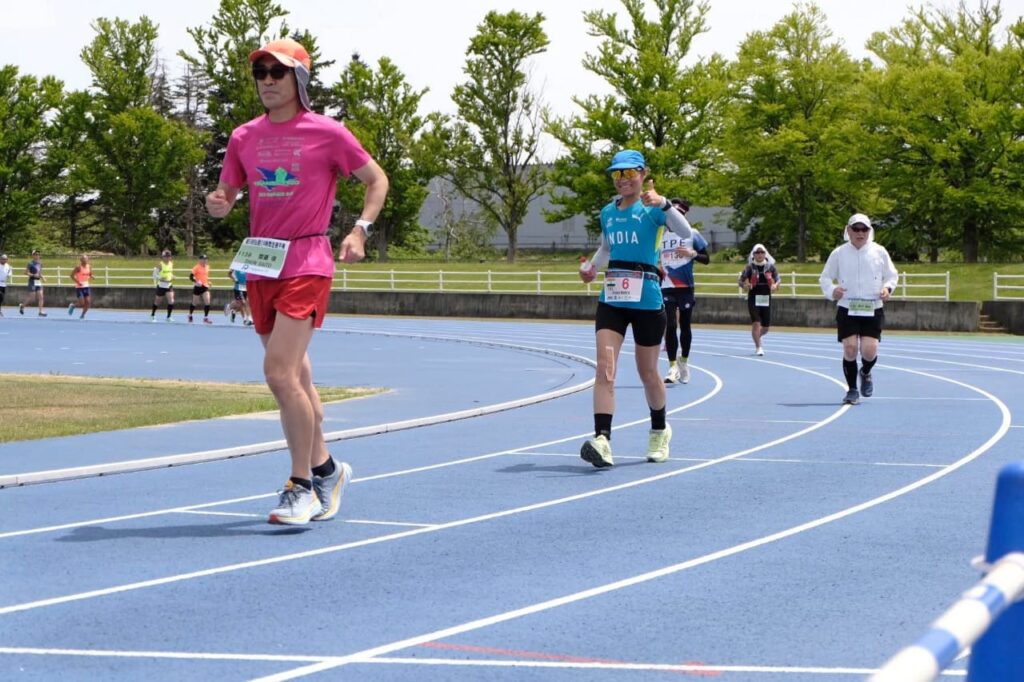
I continued moving steadily until the end and completed 176.7 km in 24 hours.
Explore more : Hybrid Training for Runners: Combine Strength & Endurance Without Burnout
Reflection on the Performance

For me, this race was not about chasing a personal best. It was about executing under constraints — limited recovery, incomplete preparation, and managing a sensitive knee condition.
What mattered most was that I was able to stay in control throughout the race. I did not face any situation where the race forced me to stop or completely break down. Instead, I was able to manage the effort intelligently from start to finish.
In ultra-running, that sense of control over 24 hours is often more meaningful than raw distance alone.
Explore more : Overtraining in Runners: Recognize, Prevent & Recover
Indian Team Performance


This IAU 24 Hour Asia Oceania championship was also a historic one for the Indian team, with exceptional performances across categories.
Amar Singh Devanda won the gold medal with a phenomenal performance of 282.881 km, also setting a new national record. His run was marked by consistency and strength throughout the entire duration.
In the women’s category, Tenzin Dolma delivered an outstanding performance of 228.93 km, setting another national record and finishing 4th overall in a highly competitive international field.
Overall, the Indian men’s team secured the gold medal, while the women’s team earned the bronze medal. These results mark a significant milestone for Indian ultra-running at the Asian and Oceania level.
Experience of the 24-Hour Format
The 24-hour race format of IAU 24 Hour Asia Oceania Championship is one of the most unique and demanding events in endurance sports.
Running continuously for an entire day is not just a physical challenge but also a mental and biological one. The body goes through multiple cycles — energy highs, fatigue drops, sleep signals, and moments of complete emptiness.
Despite this, the only option is to keep moving forward — sometimes running, sometimes walking, but always progressing.
As the hours pass, the challenge becomes increasingly mental. It turns into a continuous conversation with the mind — managing discomfort, maintaining focus, and staying emotionally stable.
What makes this format even more special is the environment on the course. You see athletes from different countries, all going through their own struggles. Some are strong and steady, some are battling pain, and some are simply trying to continue step by step.
There is an unspoken connection among all runners. Even without words, there is mutual understanding and respect. Everyone knows what everyone else is going through.
Closing Thoughts

Although this race – IAU 24 Hour Asia Oceania Championship, was not about numbers or personal records for me, it was still a deeply satisfying experience.
The real value came from execution — staying disciplined, managing the body, and completing 24 hours in a controlled and stable manner.
This experience reinforced an important aspect of ultra-running: progress is not only about running faster or farther, but also about learning how to manage yourself better over time.
For me, the 24-hour format continues to remain special — not just as a race, but as a space where endurance, patience, and human resilience come together in a very pure form.